June 11, 2025
Traditions at Epiphany: Icons
by parishioner Dick Fichter with assistance from Rev. Dina
Last week we discussed the inlaid marquetry of The Last Supper and noted that it was on the Nave’s east wall between two icons. Icons as a tradition in the Episcopal Church, not so much. When one thinks of icons, usually you think of them with respect to the Easter Orthodox church. Let’s see what the Episcopal glossary has to say about icons by way of background.
The traditional icon is a stylized religious picture that is usually “painted” on a wood panel in egg tempera. Icons are not so much painted as they are written. Icons depict Christ, the Trinity, St. Mary, other saints, and events in the gospels and lives of the saints. Icons have been used in both eastern and western churches. Icons were painted or placed on the walls of churches and on interior beams and screens. They were also displayed in private houses and at wayside shrines.
The oldest extant icons date from the fifth century. The Seventh Ecumenical Council of 787 determined that the use of icons is supported by the Incarnation, in which the Word of God united to created human nature and thus to matter in general. That Council also taught that the honor given to an icon passes to that which it represents. The eastern churches developed the icon tradition extensively. In the west the tradition was eclipsed by the Renaissance and other artistic movements. However, offshoots of the icon tradition in the west include the use of stained-glass windows and the illustrations in manuscripts and liturgical books. Today there is a revival of the use of icons in the western churches, including the Episcopal Church.
But what about the second commandment received by Moses before the birth of Jesus: “You shall not make for yourself a carved image, or any likeness of anything that is in heaven above, or that is in the earth beneath, or that is in the water under the earth. You shall not bow down to them or serve them.”
Iconoclasm The term means “the smashing of icons.” The most important iconoclastic controversies occurred in the seventh and eighth centuries. These controversies led to the Seventh Ecumenical Council of 787. The orthodox party urged that in the Incarnation deity was united to created human nature, so it is appropriate to make material images of Christ. There have been other iconoclastic movements in Christian history, notably during the Protestant Reformation. For example, English Puritans attacked the use of church ornaments and vestments.
The Seventh Ecumenical Council, held in Nicaea in 787, primarily addressed the Iconoclast Controversy, a debate about the use of icons in religious art. The council affirmed the veneration of icons, distinguishing it from idolatry, and condemned the iconoclast movement which sought to eliminate them. It also established the tradition of relics in altars, a practice retained by both modern Catholic and Orthodox churches.
In Our Nave
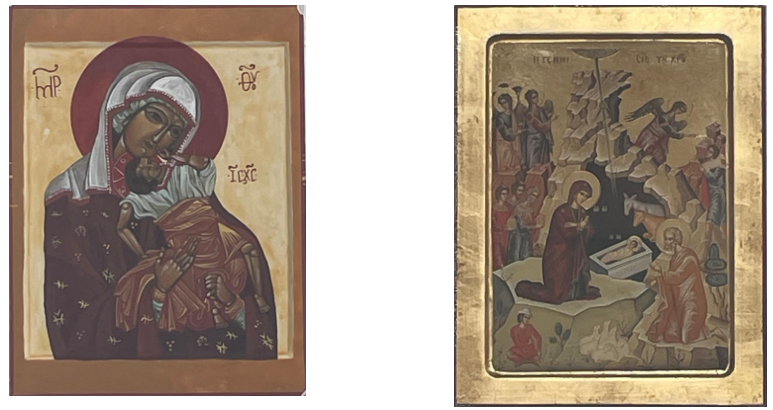
We currently have two icons in the nave.
One is of the Madonna and Child Jesus. It was written by Sonya Payne. Ms. Payne is head of Art at the British International School of Manhattan.
The other icon is called Nativity of our Lord Jesus Christ. Its writer is unknown.
Can you find another icon, not in the nave? Do you know where it is? Look around the narthex. See what you can discover!