
July 16, 2025
Congregational Singing – an Introduction
In considering traditions at Epiphany, one is music. Music is one of the oldest traditions in all types of religious and cultural settings from the beginning of time. Music is emotionally stirring and powerful in its effect. In line with the Episcopal Church, we at Epiphany value music as a part of our Sunday worship at 10 a.m. We also often include it in special or seasonal worship services, like the evening contemplative worship or Easter service.
In biblical times, professional singers chanted psalms during Jewish religious services. Occasionally, the congregation incorporated a short refrain between the chanted verses but there was no congregational singing as we know it.
Before the Reformation, singing was only for the ordained clergy and trained musicians.

It was not until the Reformation that hymns were sung by the congregation in their vernacular language, instead of the traditional Latin texts. The Reformers believed that singing should be a way for everyone to express their faith and engage in worship. In addition to turning to the vernacular, they wrote hymns with easier melodies. Music is a way to build community and unity between and among those worshipping.
The foundation of our Episcopal music has roots in the 15th century when Catholic boys’ choir schools were established to train young boys to lead worship in parishes and cathedrals.
Over time, the music in cathedrals and in parishes began to merge. In large cathedrals, the choirs were traditionally well-trained and could easily execute difficult pieces of choral music. Parishes did not have similar resources, so congregational singing emerged out of necessity and was borrowed from the Lutherans and Calvinists, who engaged in congregational hymn-singing from the start.
The introduction of the Book of Common Prayer (BCP) and its revisions significantly impacted the music of the church. Two offices, Matins (Morning Prayer) and Evensong (Evening Prayer), replaced the eight offices of the monastic tradition. It also offered new translations of texts, including graduals, alleluias, tracts, sequences, antiphons, and responsories.
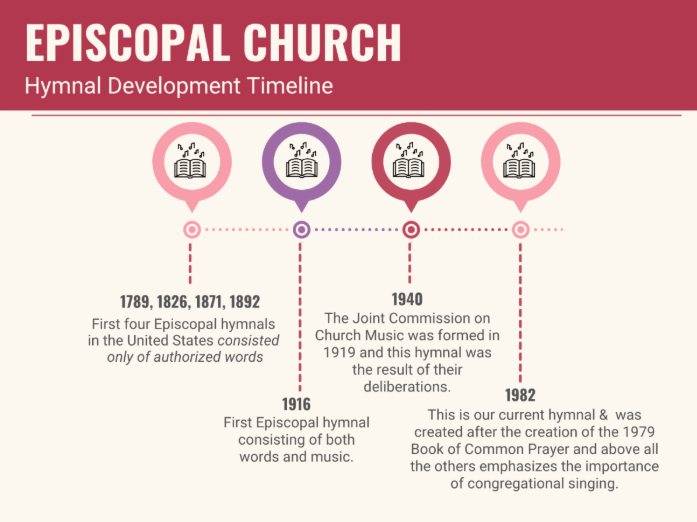
See below to see about the development of the Episcopal Church hymnal.